
⚡ Intelligent AI Infrastructure Platform
One Intelligent Platform for
Modern Private Cloud
Consolidate infrastructure silos into a unified private cloud platform for virtual machines, containers, Kubernetes, storage, GPU workloads, and AI-driven operations.
Built for enterprise infrastructure teams modernizing datacenters and distributed environments.
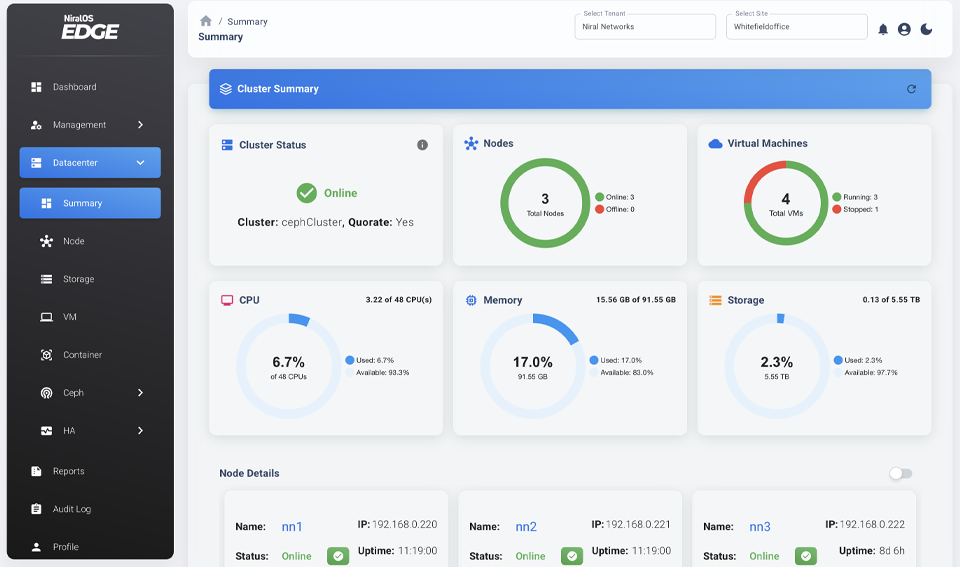

NiralOS EDGE v2.6.0 Release Notes
NiralOS EDGE v2.6.0 focuses on improving the first-time deployment experience, simplifying Kubernetes onboarding, enhancing Docker connectivity, strengthening licensing security, and introducing seamless in-place upgrades. This release also includes multiple installer improvements and important bug fixes to improve platform stability and usability.
- Redesigned Initial Setup Wizard
- Kubernetes authentication using KubeConfig
- Smart Interactive Installer with in-place upgrades
- Custom Docker Remote API port support
- Improved license fingerprinting
- Multiple installer and platform stability improvements
New Features
Initial Setup Wizard
A completely redesigned Initial Setup Wizard simplifies first-time deployment by guiding administrators through the complete onboarding process.
- Create the first Tenant
- Create the first Site
- Connect the first Environment
- Skip environment onboarding for later configuration
- Reduced deployment time for new installations
Kubernetes Connection Using KubeConfig
Kubernetes environments now use a standard KubeConfig file for authentication and cluster discovery.
- Simplified Kubernetes onboarding
- Improved compatibility with standard Kubernetes distributions
- Secure authentication using existing cluster credentials
- Automatic deployment of the NiralOS EDGE Agent after successful connection
Smart Upgrade Facility
The Interactive Installer now supports seamless in-place upgrades for existing deployments.
- Automatically detects installed versions
- Checks for newer releases
- Downloads the latest release
- Preserves existing application data
- Restarts platform services with minimal downtime
Custom Docker API Port
Docker environments can now connect using custom Docker Remote API ports, providing greater deployment flexibility.
Improved License Fingerprinting
The licensing subsystem now provides stronger hardware fingerprint generation and validation for improved licensing security and protection against unauthorized usage.
Improvements
Platform
- Improved first-time onboarding experience.
- Simplified environment creation workflow.
- Improved Kubernetes environment registration.
Installer
- Added automatic upgrade detection.
- Improved installation validation.
- Enhanced installer reliability.
Docker
- Support for custom Docker Remote API ports during environment registration.
Licensing
- Enhanced hardware fingerprint generation for license validation.
Bug Fixes
Installer
- Fixed an issue where the uninstaller ignored stopped Docker containers during cleanup.
- Fixed an issue where the installer exited unexpectedly if Docker Engine was installed but not running.
Licensing
- Fixed an issue preventing One-Time Password (OTP) delivery during certain authentication workflows.
- Fixed an issue where license activation failed for certain international phone number formats.
General
- Multiple minor stability improvements.
- Various UI and backend bug fixes.
- General performance and reliability enhancements.
Breaking Changes
Upgrade Notes
Before Upgrading
- Ensure Docker Engine is installed and running.
- An active Internet connection is available to download the latest release.
- The current user has permission to manage Docker resources.
During the Upgrade
- Existing application data is preserved.
- Docker volumes are retained.
- Platform services experience only minimal downtime.
Compatibility
| Component | Support Status |
|---|---|
| Windows | ✔ Supported |
| Linux | ✔ Supported |
| macOS | ✔ Supported |
| Docker Engine | ✔ Supported |
| Kubernetes | ✔ Supported via KubeConfig |
| K3s | ✔ Supported |
| Proxmox VE | ✔ Supported |
Known Issues
Previous Release (v2.5.0)
The previous release introduced major infrastructure management capabilities across multiple virtualization and container platforms.
- Centralized orchestration of Proxmox VE, Docker, and Kubernetes environments from a single dashboard.
- Multi-environment infrastructure management.
- CEPH storage management and monitoring.
- Support for Multi-Tenancy.
- Support for Multi-Site Management.